Wednesday, November 7, 2012

The Birchbark House (Erdrich)


Erdrich, Louise. The Birchbark House. New York: Hyperion Books for Children, 1999. ISBN 780786814541
PLOT SUMMARY
The Birchbark House is a thoughtful depiction of Omakayas as she goes through a pivotal year in her young life. Set in 1847, Omakayas is an eight year-old girl of the Ojibwa. The reader follows her through the four seasons as her family creates a birchbark house by the lake, prepares for the coming winter, moves into their winter home in town and suffer through hunger and sickness. Finally the book concludes with Omakayas finding spiritual and physical healing.  
CRITICAL ANALYSIS
The Birchbark House is the beautiful story of Omakayas, a strong spirited child who deals with typical childhood woes. Her older sister does not pay her enough attention, her younger brother is annoying, and she hates her chores. However typical as this may seem, Omakayas is far from average. She has a special gift: she can converse with a bear, her spirit guide! 
Through the course of the story, Omakayas and her family experience the effects of white settlers moving west. She learns first hand of the devastation and death brought through English settlers as her family contracts “the scratching disease” or smallpox. 
Through the course of a year, Omakayas experiences great loss, learns of her terrifying past, and comes to understand her future. With the help of the strong women in her life, Omakayas learns to quietly listen as “dizzy spells” pass over her. She comes to understand that when she listens closely she is able to gain information from her spirit guides that will eventually assist her in healing others.
Through Omakayas, Erdrich is able to weave together a picture of what daily life was like for the American Indian Ojibwa people in the 1847. Edrich explains that she uses information found in her search for information about her own heritage to give vivid descriptions of Omakaya’s life. The reader learns through Omakayas of the tedious tasks of scraping hides to create the materials necessary for “makazins” and of drying berries to flavor winter soups. The reader also experiences with Omakayas traditional Ojibwa stories as they are orally passed to her from her father “Deydey” and her grandmother “Nokomis.”
Edrich incorporates poetic Ojibwa speech patterns and language throughout the novel. For example, when Omakayas’ grandmother retells the story of how their island came to be she explains how “Nanabozho blew on Muskrat until he came back to life” and eventually how these actions led to “this earth we are on today.” Words belonging to the Ojibwa language are often defined through the story’s context, but are always included in the glossary and pronunciation guide at the story’s conclusion. By flipping to the glossary, readers can learn that Nanabozho of grandmother’s story is a “great teacher of the Ojibwas.” 
Erdrich has also included small black and white sketches at the beginning of each chapter and periodically throughout the text. Younger readers will find the illustrations helpful in visualizing unfamiliar scenes. For example, the image of Omakayas scraping a hide with a new tool given to her by her father will help reader’s understanding of the laborious process. Another image demonstrates Omakayas’s sister’s new outfit sewn by their mother, while other illustrations show the variety of clothing styles and appearances of her father and his friends. All of these images provide critical additional information to the reader as they may be reading of unfamiliar settings, clothing styles, and ways of life.
REVIEW EXCERPTS
Publisher’s Weekly: “Against the backdrop of Ojibwa cultural traditions, Omakayas also conveys the universal experiences of childhood.”
School Library Journal: “deftly drawn characters, relationships that ring true, and fascinating details about the daily life of the Ojibwa”
Kirkus Reviews: “a novel that is by turns charming, suspenseful, and funny, and always bursting with life.”

CONNECTIONS
Continue reading books in Erdrich’s Birchbark House series:
Erdrich, Louise. The Game of Silence. ISBN 9780064410298
Erdrich, Louise. The Porcupine Year. ISBN 9780064410304
Erdrich, Louise. Chickadee. ISBN 9780060577902

Learn about modern members of the Ojibwa people by reading these books:
Bial, Raymond. The Ojibwe. ISBN 9780761408635
King, Sandra. Shannon: An Ojibway Dancer. ISBN 9780822596431

Learn more about the legends of Nanabosho by reading books by Joseph McLellan, available through Oyate.com. 
McLellan, Joseph. Nanabosho and the Woodpecker. Ill. by Rhian Brynjolson. 1989.
McLellan, Joseph. Nanabosho: How the Turtle Got Its Shell. Ill. by Rhian Brynjolson. 1989.
McLellan, Joseph. Nanabosho, Soaring Eagle, and the Great Sturgeon. Ill. by Rhian Brynjolson. 1994.

Learn facts about the Ojibwa people at this website:
American Indians for Children. “Ojibway Fact Sheet.” http://www.bigorrin.org/chippewa_kids.htm 

Code Talker (Bruchac)


Bruchac, Joseph. Code Talker: A Novel About the Navajo Marines of World War Two. New York: Dial Books, 2005. ISBN 0803729219
PLOT SUMMARY
Ned Begay is just a young child when he is sent away from his family and Navajo reservation in order to attend a boarding school. There he is expected to learn the ways of white men in order to protect his people and reassure others that the Navajo will “always be friends of the United States.” While at boarding school, Ned faces harsh prejudice, but still manages to excel in his studies. Once World War II begins, however, Ned begins a new journey. He joins the marines and enters the war where his Navajo customs and language are no longer ridiculed, but praised and much needed. This historical novel uses the fictitious character, Ned Begay, to tell the story of how courageous Navajo marines fought for the United States while staying true to the traditions and values of the Navajo.

CRITICAL ANALYSIS
In Code Talker, Ned Begay orally narrates his story with the reader. He brings the reader into his life, referring to the reader as one of the “grandchildren” and often reminding the reader of what and how “we Navajo” see and do things. The tale provides vivid, sometimes brutal, but always accurate descriptions of his life and World War II. When he is first sent to boarding school he describes having his hair cut off as feeling “naked and ashamed.” Later, he describes the experience of war and is honest about how some struggled with coping. Begay explains how “war is a sickness that must be cured” and “is a time out of balance.” 
Many Navajo traditions are introduced through the natural course of the story, such as placing pollen on one’s tongue in the mornings and Blessingway Ceremonies. The meshing of Catholic and traditional Navajo religious beliefs are explored by Ned Begay, as are differences in experiences for Navajo during Ned Begay’s youth and for the Navajo youth of today. 
The complex and beautiful Navajo language is presented throughout the novel. Ned Begay recounts the harsh punishments by his teachers for speaking in Navajo. Later, Ned explores the joy, healing, and pride that slowly returns to him as he is encouraged and praised for using his primary language in order to pass secret codes through the American armed forces. The reader learns how not everything can be directly translated from English into Navajo and vice versa. The reader also learns how Navajo is a complex language, and how Navajo men and women from different regions have different dialects, making the work of code talkers even more difficult. As Ned Begay narrates he provides translations for words like “Nihima” (our mother) and “Na’ats’oosi” (mouse) without ever patronizing the reader.
Code Talker is a fictional, war time book that provides factual history on the contributions of Navajo marines in World War Two and on Navajo culture while entertaining readers with its captivating storytelling.

REVIEW EXCERPTS
Booklist: “Readers who choose the book for the attraction of Navajo code talking and the heat of battle will come away with more than they ever expected to find.”
Kirkus Reviews: “With its multicultural themes and well-told WWII history, this will appeal to a wide audience.”
School Library Journal: “Bruchac's tale is quietly inspiring.”

CONNECTIONS
Learn more about Navajo Code Talkers through a collection of photography.
Kawano, Kenji. Warriors: Navajo Code Talkers. ISBN 9780873585132

Learn about World War II through the eyes of Japenese Americans.
Mochizuki, Ken. Baseball Saved Us. ISBN 9781880000199
Uchida, Yoshiko. The Bracelet. ISBN 9780698113909

Read other books for young adults written by Joseph Bruchac.
Bruchac, Joseph. Hidden Roots. ISBN 9780557711680
Bruchac, Joseph. The Heart of a Chief. ISBN 9780141312361
Bruchac, Joseph. Skeleton Man. ISBN 9780064408882
Bruchac, Joseph. The Return of Skeleton Man. ISBN 9780060580926

Wednesday, October 17, 2012

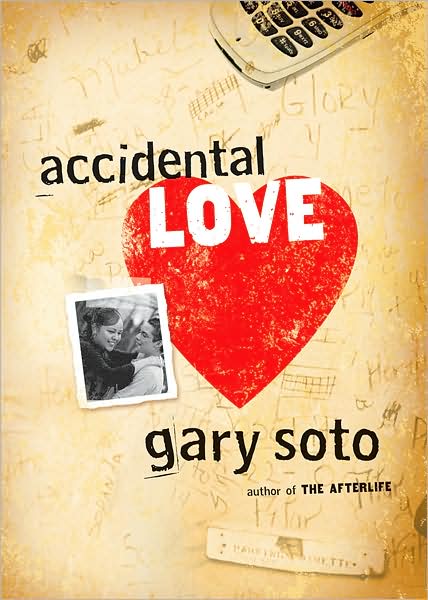
Accidental Love (Soto)


Soto, Gary. Accidental Love. Orlando, Florida: Harcourt, 2006. ISBN 9780152054977

PLOT SUMMARY
Marisa, a 14 year-old hispanic girl from the wrong side of town, makes major life changes after a chance encounter with Rene, a cute nerd. Marisa had always been a tough “homegirl”, but inspired by Rene, Marisa begins to spend more time studying and works on controlling her temper. Her parents even allow her to bend the rules and transfer to Rene’s school for a better education. Marisa begins loosing her extra weight, increases in self confidence, and sets new goals for her life once her and Rene become a couple. However, after Marisa and Rene are separated and Marisa must return to her derelict school, Marisa decides the changes she made were ultimately for herself and would remain a part of her regardless of where she is or who she is with. Accidental Love is a humorous, coming of age story in which a young girl experiences first love and in the process discovers who she is and where she is headed in life.

CRITICAL ANALYSIS
Gary Soto has created an authentic, ethnically rich novel for young adults in Accidental Love. Marisa’s life is filled with language, food, and style that represents her Latino and American heritage. Her story manages to both represent and break many stereotypes, especially those of the Mexican-American culture. 

Marisa, her family, and Rene, like many bilingual speakers, use a mixture of languages throughout their day. Marisa’s mother asks, “How are you, mi’ja?” using a Spanish term of endearment. Throughout the novel emotional responses of any kind are often a mix of language. Marisa affectionately calls her boyfriend “my precious nerdito” and later angrily yells in English, but throws in a sprinkling of mild  Spanish curses. Marisa’s language is somewhat rough and improper, but her boyfriend Rene Torres, provides a glaring contrast with his extensive vocabulary and well phrased sentences.

Spanish is also used in the book when an English equivalent does not adequately describe the situation. For example, Marisa’s original school is being described as filled with “cholos,” or Latino gang members, and Asian and White students who use Spanish words like “mi jefita” to fit in with the majority. Soto has created a novel that, while written in English, may prove somewhat confusing to those unfamiliar with the Spanish language. In such cases the glossary of selected spanish words and phrases will be much appreciated by the reader.

Marisa and her family eat albondigas, a traditional Mexican meatball soup, have enchilada’s on Wednesdays, and use tortillas to eat their refritos. However, she and her family also indulge in American classics, such as lasagna, chocolate ice cream, powdered donuts and barbecue potato chips. Food becomes an important part of Marissa’s struggle when she decides to lose weight. Marissa deals with food cravings as she forgoes junk food and decrease portions of her favorite foods, including her favorite cheesy enchiladas.

The clothing and styling differences of Marisa and Rene represent their differences.  Rene tends to dress in a “nerdy” way, wearing high-water “pantalones” and white socks to school. Rene’s meek look appeases Marisa’s parents, but  is slightly embarrassing for his girlfriend. In comparison to Rene, Marisa dresses more like a gangster, wearing “brown lipstick and teased hair.” This look causes Marissa to feel judged occasionally, specifically by Rene’s mother. 

The couple’s look mirrors their stereotype breaking relationship. The female, Marisa, is the stronger and tougher of the two and protects Rene from teasing and abusive situations. In the end, the couple teaches each other how to be better versions of themselves, not for the other, but for themselves. Rene learns to stand up to his bullies, including his own mother and Marissa learns to control her anger. This change is represented, once again, in clothing. By the end of the novel Rene is wearing modern jeans and blue socks while Marissa begins wearing red lipstick and a dress!

REVIEW EXCERPTS
Booklist: “With humor and insight, [Soto] creates memorable, likable characters.”

Kirkus Reviews: “fresh and fun”

Publishers Weekly: “Soto accurately depicts popularity and stereotypes in high school, while conveying a melting pot of cultures.”

School Library Journal: “warmhearted, humorous novel”

CONNECTIONS
Read other novels by Gary Soto:
Soto, Gary. The Afterlife. ISBN 9780152052201
Soto, Gary. Jesse. ISBN 9780590528375
Soto, Gary. Taking Sides. ISBN 9780152046941

Variety of novels where young teenagers make important decisions and discover who they want to be:
Lipstyle, Robert. One Fat Summer. ISBN 9780060238964
Munoz Ryan, Pam. Esperanza Rising. ISBN 978-0439120425
Schmidt, Gary D. Okay For Now. ISBN 9780547152608

A Gift of Gracias (Alvarez)


Alvarez, Julia. A Gift of Gracias: The Legend of Altagracia. Ill. by Beatriz Vidal. New York: Alfred A. Knoff, 2005. ISBN 9780375984822

PLOT SUMMARY
A young girl named Maria becomes part of a miracle when she dreams of a lady clothed in stars. Following the mysterious lady’s advice, Maria and her family plant seeds of oranges while giving thanks to God. The seeds grow into orange trees at an unimaginable rate, producing an abundance of fruit that saves her family from financial ruin. An image of Our Lady of Altagracia later appears on a blanket, from which she continues to perform miracles for Maria and her family.

CRITICAL ANALYSIS
A retelling of the Our Lady of Altagracia legend, A Gift of Gracias is set in Spanish colonized Dominican Republic. Maria and her family live on a farm, where all attempts to grow traditional Spanish olives are failing. When her father suggests that the family may soon be leaving their home to live in the city, Maria begins to cry into a bowl of oranges. Vidal’s beautiful paintings of the farm’s magnificent, lush landscape leave the reader with little doubt as to why leaving would be such a sad prospect for Maria. 

Later that night, an old family friend, Quisqueya, appears in Maria’s dreams. His dark, weathered face is contrasted next to the youthful, pale face of Maria as he tells her to plant orange seeds. In her dream they plant the seeds together, giving thanks. Soon a beautiful, unearthly women appears to them. She radiates light, both through her aura and her starlit robe as she tells Maria what to do next. Vidal’s paintings portray Our Lady of Altagracia very traditionally, staying true to images found across the Dominican Republic and displayed in Catholic churches.   

After Maria wakes up she quickly relays her dream to her family. Quisqueya, already familiar with the legend of such a lady, and her family quickly agree to the plan. The miracles continue even after the trees produce an abundance of fruit. Maria continues to receive dreams of the future, including images of their oranges selling in a vibrant, diverse marketplace, filled with light skinned Spaniards wearing European styled clothing and dark skinned Tiano Indians wearing vibrant robes. 

The story also explains how other countries have differing images of the Virgin Mary, based on how the Virgin appeared in their country. 

Alvarez intertwines beautiful imagery and Spanish words into her story. Cognates are used throughout the story, such as Mamá and Papá. More challenging words, such as bandidos are placed in italics. Context clues give adequate information to the reader without being patronizing. Powerful imagery adds depth and entices the senses. Oranges are explained as smelling “sharp and fresh” and Quisqueya’s face as “glow[ing] like an indoor sun”. The combination of Avarez’s flawless integration of Spanish and descriptive imagery, when paired with Vidal’s layered, warm paintings create a stunning retelling of a tradition very close to the heart of many Dominicans.

REVIEW EXCERPTS
Booklist: “this talented team evokes an enchanted, sun-kissed world where dreams, and gratitude, bear fruit.”

Publishers Weekly: “author and artist make dreams-come-true seem possible”

School Library Journal: “Vidal has painted colorful, yet warm illustrations that add depth to the story.”

CONNECTIONS
Read other books emphasizing the importance of thankfulness.
Bucchino, John. Grateful: A Song of Giving Thanks. ISBN 9780060516338
McCourt, Lisa. The Most Thankful Thing. ISBN 9780439650830
Mora, Pat. Gracias/Thanks. ISBN 9781600602580
Polacco, Patricia. Thank you, Mr. Falker. ISBN 9780399257629
Scotton, Rob. Splat Says Thank you! ISBN 9780061978746
Wilson, Karma. Bear Says Thanks. ISBN 9781416958567

Read a few stories with Our Lady or The Virgin Mary.
Heffernan, Eileen. Blessed Jacinta and Francisco Marto: shepherd of Fatima. ISBN 9780819811554
Lovasik, Lawrence G. Our Lady of Lourdes. ISBN 9780899423913
Milligan, Bryce. Brigid’s Cloak: An Ancient Irish Story. ISBN 9780802852243
Mora, Pat. The Beautiful Lady: Our Lady of Guadalupe. ISBN 9780375868382
dePaola, Tomie. The Lady of Guadalupe. ISBN 9780823404032
dePaola, Tomie. Mary: The Mother of Jesus. ISBN 9780823410187

Dizzy In Your Eyes (Mora)


Mora, Pat. Dizzy In Your Eyes: Poems About Love. New York: Alfred A. Knopf, 2010. ISBN 9780375843754


PLOT SUMMARY
Dizzy In Your Eyes is a collection of poems by Pat Mora that explore the intricacies of love. A teenager’s love for self, family, pets, and especially a romantic other are explored through 50 poems. Various poetic forms, both familiar (e.g. haiku and free verse) and unfamiliar (e.g. vinanelle), are explored in Mora’s Spanish infused collection.

CRITICAL ANALYSIS
Love is a universal theme that is very familiar with poetry. Mora has used poetry to explore the meaning of love in its vast variety of forms. Poems cover mundane topics, such as weekend plans, to very special memories, like the first time successfully asking a girl out. 

Mora shows her strength when she uses poetry to tell stories, breaking free of some of the more rigid poetic forms. These poems evoke rich and authentic emotions. The pure essence of secret joy is expressed in “Back Then” when Mora writes “I’d feel like I’d swallowed a slice of sun.” Once again, in “Kissing” Mora perfectly captures the moment. In a tense scene at home after a father catches his daughter kissing a boy Mora writes, “Dad and I tangled in silence.” 

The theme and format of the collection is universal to all cultures, although many of its poems speak directly to Hispanic culture. For example, “Mariachi Fantasy” references the passionate musical groups traditional to Mexico as it creates a playful image of a cactus “letting all his inside feelings rip”.  The poem “Spanish” looks into one teen’s love for their native language and loss when they are unable to hear and speak it. This poem will feel familiar to many individuals who have been in the lingual minority, and even more so for those whose primary language is Spanish. The idea of language providing “comfort, una frazdo” will be impactful for those who can fully embrace Mora’s use of metaphor. 

Spanish is utilized throughout the collection in a variety of poems, with one poem, “Ode to Teachers” being presented in both Spanish and English. In the touching poem, “Valentine to Papi” Spanish is only used as a tribute to the fact a girl never grows out of love with her father, her “Papi.”

REVIEW EXCERPTS
Kirkus Reviews: “The poet's voice is multifaceted: tender, humorous and joyful but also profound”

School Library Journal: “a glimpse into the last remaining innocence of the teen years”

CONNECTIONS
Read more poetry by Pat Mora.
Mora, Pat. This Big Sky. ISBN 0590371207
Mora, Pat. Yum! Mmmm! Qué Rico!, Americas' Sproutings. ISBN 9781584302711
Mora, Pat. Confetti: Poems for Children. ISBN 9781880000854
Mora, Pat. Love to Mama: A Tribute to Mothers. ISBN 9781584302353
Mora, Pat. My Own True Name: New and Selected Poems for Young Adults. ISBN 9781558852921

Read another poetry book that explores a variety of poetic forms.
Janeczko, Paul B., ed. A Kick in the Head, An Everyday Guide to Poetic Form. ISBN 978-0763641320

Read other poems for teenagers told from the viewpoint of teenagers.
Franco, Besty. Falling Hard: 100 Love Poems by Teenagers. ISBN 9780763648398
Marcus, Kimberly. Exposed. ISBN 978-0375866937
Ochoa, Annette Pina, Betsy Franco, and Traci L. Gourdine, eds. Night is Gone, Day is Coming: Stories and Poems by American Indian Teens and Young Adults. ISBN 0763615188
Sones, Sonya. Stop Pretending, What Happened When My Big Sister Went Crazy. ISBN 0064462188

Wednesday, October 3, 2012

Feathers (Woodson)


Woodson, Jacquline. Feathers. New York: G.P. Putnam’s Sons, 2007. ISBN 9780399239892

PLOT SUMMARY
Feathers opens with Frannie explaining her confusion over Dickinson’s description of hope as a “thing with feathers.” Over the course of the book, however, Frannie begins to understand hope as a multifaceted thing. She feels hope in the white child that shows up suddenly at the all black school she attends in the 1970s. She feels hope in her much admired older brother who perseveres through peer rejection because he is deaf. She feels hope in her best friend who holds fast to her faith in God despite poverty and disappointment. Finally, she feels hope within her own family as together they face their mother’s new pregnancy after miscarriage. In Feathers Frannie comes of age as she discovers the importance of having, experiencing, and holding on to hope in the everyday.

CRITICAL ANALYSIS
Jacqueline Woodson’s beautifully written book is the story of keeping hope despite life's setbacks and circumstances. 

Frannie, the book’s main protagonist, is a sixth grade girl that is well loved by her family. Although she wishes for some of her best friend Samantha’s gracefulness or the “dark, pretty skin” of her father, Frannie is pleasantly self-assured for her young age. 

Frannie’s family is tested when her mother finds out she is pregnant. Scared that her mother will have another miscarriage, Frannie begins to obsess over everything that could go wrong. It is with the support of her family, however, that Frannie comes to understand how to let go of her worry and see “each moment” as a “thing with feathers.”

The 1971, post segregation New York setting influences the culture and language of Feathers. The Black Panther's impact can be seen when Frannie’s brother picks his hair into an afro and makes the "Black Power sign." Students in Frannie’s classes “jive” and call each other “cat” and “my brother.” Although segregation has ended, students that are white live and go to school on one side of town, and students that are black live and go to school on the other side. 

The new student, Jesus Boy, causes a disruption to the status quo when he shows up to Frannie's school one January morning. He is hard to place into a category and this troubles his fellow students. He appears white, but identifies himself as black. Frannie is immediately drawn to the new boy at school, but others are not as immediately accepting. His arrival poses the question of what it means to be black and how one lives in two worlds (black/white).

Like Frannie, Jesus Boy is hearing and can sign American Sign Language. Sean, Frannie's brother, is deaf and communicates primarily through sign language. When Sean is approached and rejected by teenage girls because he is deaf, he expresses a desire to be like Frannie and Jesus Boy. He sometimes wishes that he too could cross into both worlds (hearing/deaf).

Feathers is a insightful novel that delves into the human desire for belonging and the need to hold onto hope.

REVIEW EXCERPTS
BookList: “Woodson tells her story with immediacy and realism”

The Horn Book: “Woodson deftly, even lyrically, weaves some large ideas through her story”

Kirkus Reviews: “Woodson captures perfectly the questions and yearnings of a girl perched on the edge of adolescence”

Publishers Weekly, Starred Review: “Woodson's novel skillfully weaves in the music and events surrounding the rising opposition to the Vietnam War, giving this gentle, timeless story depth”

CONNECTIONS
Read everyday poems told from a child’s point of view, from celebrated poet Greenfield.
Greenfield, Eloise. Honey, I Love. ISBN: 9780064430975

Read another child’s perspective of the same historical time period in One Crazy Summer.
Williams-Garcia, Rita. One Crazy Summer. ISBN: 9780060760908

Read about two friends and their summer following desegregation in the South in Freedom Summer
Wiles, Deborah. Freedom Summer. ISBN: 978-0689878299

Read about one boy’s experience of going with his deaf father to meet famous African-American baseball player Jackie Robinson.
Uhlberg, Myron. Dad, Jackie, and Me. ISBN: 9781561455317


The Patchwork Quilt (Jerry Pinkney)


Flournoy, Valerie. The Patchwork Quilt. Ill. by Jerry Pinkney. New York: Dial Books for Young Readers, 1985. ISBN 9780803700970

PLOT SUMMARY
In The Patchwork Quilt a young girl named Tanya observes how her aging grandmother carefully saves fabric from her family’s life and utilizes it in the creation of a quilt. Tanya learns how each square of fabric represents a family memory as she spends time with her grandmother. Before the quilt is finished, her grandmother falls ill and Tanya decides to take over the important work. Tanya’s grandmother gradually recovers, completes the quilt, and presents it as a gift to Tanya. 

CRITICAL ANALYSIS
Flourney and Pinkney have teamed up to tell a story that celebrates family traditions and the joy and importance of remembering the past. 

Flourney uses dialogue throughout the book as a way to give insight into each character. Tanya’s youth and energy are expressed through her words throughout the book, like when she asked her grandmother what she was “gonna do” with her “stuff.” Likewise, her grandmother’s traditional southern dialect was represented in the way she addressed her granddaughter throughout the book as “honey” and exclaims “hush, child” when exasperated. 

Detailed writing give the reader the opportunity to experience Tanya’s family as an insider. The reader is allowed to listen in to conflict when grandmother reprimand’s mama after she takes the role of caring for an aging parent too far. The reader also gets to experience the mundane with the family- eating homemade biscuits, making snow angels in the yard, and drinking hot chocolate. Finally, the reader gets to peek at a few of the family’s traditions- including their Christmas celebration. While Flourney’s engaging dialogue and descriptive style of writing serve to add incredible insight, the book may be too lengthy for audiences in younger grade levels. 

Pinkney uses detailed pencil and watercolor illustrations to add dimension to Flourney’s text. Pastel colors give the book warmth and welcome the reader to to notice the many subtle details. The 1980s time period of the story is clearly defined through the illustrations.  Careful attention has been given to ensuring that each character displays their individuality, in the varying shades of brown skin, differing styles of clothing, and various textures of hair styles. The true genius of Pinkney’s illustrations is found in the very realistic and expressive faces of Tanya’s family. Detailed emotions play across the faces of each family member, making each illustration seem like a candid moment in the family’s lives. 

The Patchwork Quilt is a sentimental glimpse into one African-American family. The universal theme of family and personal heritage is honored through the individual story of a child named Tanya.

AWARDS AND REVIEW EXCERPTS
The Christopher Award

Corretta Scott King Award

Booklist: “a comforting sense of strong family bonds”

Kirkus Reviews: “Pinkney's pictures glow softly and abound in loving smiles.”

CONNECTIONS
Have each student create a patch that represents themselves and then “stitch” them together to create a classroom quilt!

Accompany The Patchwork Quilt with poems about peace and illustrations made of actual quilts.
Hines, Anna Grossnickle. Peaceful Pieces: Poems and Quilts About Peace. ISBN: 9780805089967

Read other books about families, quilts, and the act of remembering!
Mills, Lauren. The Rag Coat. ISBN: 9780316574075
Polacco, Patricia. The Keeping Quilt.  ISBN: 9780153052125
Stroud, Bettye. The Patchwork Path: A Quilt to Freedom. ISBN: 9780763635190