Thursday, October 13, 2011
Mirror, Mirror (Poetry)
Singer, Marilyn. Mirror, Mirror. Ill. by Josee Masse. New York: Dutton Children’s Books, 2010.
Plot Summary
The book brings to light the difference one’s point of view can make. Mirror, Mirror is an amazing poetry puzzle that can be read from beginning to end and end to beginning resulting in new takes on the same story. This new type of poetry, the reversible verse or reverso, makes for interesting and playful character studies of classic fairy tale heros, and the occasional villain.
Critical Analysis
This book of reversos will have both adults and children captivated by its unique charm and creativity. Popular fairy tale characters come to life in new ways as Singer allows them to express their perspective.
The layout of the book has been chosen to emphasize the alteration of the poems, as each reverso is paired side by side with its counterpart. In the same way, Masse has provided vivid illustrations for each side of the poem. They are juxtaposed perfectly next to each other. Bright crisp images divide pages in half and yet they comfortably entwine, showing the connection of stories.
The poem “Have Another Chocolate”, based on the story of Hansel and Gretel, is a great example of the books entirety. It demonstrates the dichotomy between the main characters by merely placing carefully worded lines in reverse and changing some punctuation. This combined with the discerning use of simile and carefully chosen words create delightful twists. Suddenly images change with words and “When you hold it out/your finger/feels like a bone” becomes the sage advice of another captive in “a bone/feels like/your finger/when you hold it out.”
“In the Hood” is another poem that will appeal to readers with its strong rhythm, refreshing rhymes, and delightful diction. Readers will appreciate the dual use of the word hood. As used by the innocent Red Riding Hood it is traveling cape but when the Big Bad Wolf relates his thoughts it is his territory through which Red Riding Hood is trespassing.
Mirror, Mirror is a new and exciting look at children’s poetry that is sure to impact authors and aspiring poets of the future.
Awards and Review Excerpts
Booklist- “will have readers marveling over a visual and verbal feast”
Kirkus- “celebration of language, imagery, and perspective”
School Library Journal- “a marvel to read” with “vibrant artwork”
Connections
*Discuss point of view after reading this book of verse in reverse. Use other books to continue discussion of point of view.
Bret, Jan. Town Mouse, Country Mouse. New York: Puffin, 2003. ISBN 069811986X
Housey, Amber. Just Because: Where Another Point of View Makes a Better You! Ill by Denise Clemmensen. Ferne Press, 2011. ISBN 1933916907
Scieszka, Jon. The True Story of the 3 Little Pigs! Ill by Lane Smith. New York: Puffin Books, 1996. ISBN 0140544518
Stevens, Janet and Susan Stevens Crummel. Help Me, Mr. Mutt!: Expert Answers for Dogs with People Problems. Ill. Janet Stevens. Orlando: Harcourt Children’s Books, 2008. ISBN 0152046283
*Invite students to perform a duo of poems from Mirror, Mirror. Students will love reenacting poems, especially when given prompts and taught to manipulate their voices.
*Use Mirror, Mirror as an opening in Math to discuss the importance of position and placement. This would be particularly well suited to lessons in writing word forms of numbers and ordering numbers.
*Pair this book with a favorite fairy tale to add more complexity to students understanding of the characters.
Button Up! Wrinkled Rhymes (Poetry)
Schertle, Alice. Button Up!: Wrinkled Rhymes Ill. by Petra Mathers. New York: Harcourt Children’s Books, 2009.
Plot Summary
Button Up! Wrinkled Rhymes is a collection of poetry written from the perspective of items of clothing. Well loved childhood favorites, such as the soccer jersey and galoshes each get their own poem, as well as some still familiar, but less enjoyed items like the wool sweater. Colorful and often humorous watercolors illustrate each poem, showing animals (and human) donning their clothing with pride. The poems are upbeat and display strong rhythm, making them perfect for reading aloud to young children.
Critical Analysis
The book provides upbeat, fast paced poetry well suited to the theme of this collection. The personification of clothing items provides a unique and fresh prospective for writing poetry aimed at younger audiences. Pre-kinder and kindergarten students will find the topics relevant and a comfortable place to begin learning poetry.
The poems demonstrate clear, but occasionally forced rhymes. For example, in "Hand-me-down Sweatshirt" the rhyme becomes confusing and feels unnatural when the sweatshirt explains it “was passed down to may/ she passed me to Karly/ I’m Andrew’s today.”
Despite some weaknesses, the collection is interesting and fun. In "Clyde’s Costume", Schertle uses a combination of alliteration, rhythm, and easy rhyme that will engage young listeners. Other poems, such as "Jennifer’s Shoes" provides strong tactile and visual information that captivate the senses. Readers will involuntarily wiggle their toes when they hear “toes are curled/the softness of carpet/ the steepness of stair/the curve of the chair”. The "Song of Harvey’s Galoshes" will be another favorite when read aloud with its repetition and sing-song use of onomatopoeia, “Squash-galosh, squash-galosh, through the slime” that will have children eagerly chiming in.
Some of the poems will create an immediate emotional connection with the reader, perfectly expressing a point of view and sentiment. Listeners will connect with "Rick’s Wool Sweater" when he admits guilty pleasure, “Still.../To tell the truth it tickles me/To be a little prickly.” The poems are meant to entertain and do so wonderfully.
The illustrator has created bright, cheerful, and quirky images of joyful animals with her watercolors. There is a great sense of textural quality to the paintings that will allow readers to study the pictures carefully. Certain images, such as the illustration for The "Song of Harvey’s Galoshes" provide a strong sense of movement which serves to provide a carefree joy to the work.
Awards and Review Excerpts
Booklist- “begs to be read aloud”
Children’s Literature- “whimsical watercolor illustrations are engaging”
School Library Journal- “small, snappy verses”
Connections
*Have students create poems from the perspectives of familiar objects (such as the crayon) in the classroom and create a class book.
*Teach rhyme to younger students using poems with strong rhymes, such as “Bill’s Blue Jacket” and “Hand-me-down Sweatshirt”.
*Use the familiar clothing items in the poems to work on visualization. Read a poem aloud to students without sharing the illustrator’s image. Have students create and share their own illustrations.
*Follow up Button Up! with The Man Who Wore All His Clothes as a read aloud chapter book with non readers or as an independent text for readers.
Ahlberg, Allan. The Man Who Wore All His Clothes. Ill. Katherine McEwen. London: Walker Childrens Paperbacks, 2002. ISBN 0744589959
One of Those Hideous Books Where the Mother Dies (Poetry)
Sones, Sonya. One of those hideous books where the mother dies. New York: Simon & Schuster Books for Young Readers, 2004. ISBN 0689858205
Plot Summary
This fast paced novel in verse is told through the perspective of a young teenager named Ruby. Early in the book readers discover that Ruby is no ordinary teenager, but the daughter of a recently deceased mother and an estranged father, who just happens to be a famous actor. The plot reveals the everyday turmoil and confusion of being a teenager, with common teenage themes of relocation, friendship, and first love. More unexpected, the novel follows Ruby’s emergence through the grief of losing a mother and stress of developing a relationship with her previously unknown father.
Critical Analysis
One of Those Hideous Books Where the Mother Dies is full of predictable plot and over the top scenarios, locations, and drama. Despite this, its quick pace and laugh out loud humor gives it an addictive quality similar to eating chocolate or watching a soap opera on daytime television. Teens will have fun imagining going from middle class teenager to offspring of the rich and famous. Furthermore, this book goes beyond a fun read and becomes memorable and recommendable because of the deep and honest quality of it’s star character, Ruby. The book details the personal thoughts of its main character in a language that will feel relaxed and familiar to the average American teenager. Finally the reader can openly relate to the book and make connections beyond wishful or sympathetic thinking.
The free verse of the book provides an ideal avenue to express Ruby’s many emotional states. Sones’ arrangement of stanzas and lines within each poem serve to emphasize or articulate the expression of certain emotions. For example, when Ruby uses three lines to state “Now I hate the rain” the reader fully digests how even the small things in Ruby’s life have changed since her mother’s death (208). Direct, meaningful, and occasionally laconic language will find home with reluctant and avid readers alike.
Review Excerpts
Publisher’s Weekly- “winning portrayal of a teenage girl's loves and losses”
Booklist- “acrimonious, raw, and very funny”
Kirkus Reviews- “the fulfillment of many a teen's fantasies”
Connections
*Other suggested books in verse by Sonya Sones
Sones, Sonya. What my mother doesn’t know. New York: Simon & Schuster Books for Young Readers, 2001. ISBN 0689841140
Sones, Sonya. What my girlfriend doesn’t know. New York: Simone & Schuster Books for Young Readers, 2008. ISBN 0689876033
Sones, Sonya. Stop pretending, what happened when my big sister went crazy. New York: Harper Teen, 1999. ISBN 0064462188
*University of Texas suggests these texts with related themes (http://www.edb.utexas.edu/resources/booksR4teens/book_reviews/book_reviews.php?book_id=124).
Cisneros, Sandra. House on Mango Street. New York: Vintage Press, 1991. ISBN 0679734775
Janeczko, Paul B. Preposterous: Poems of Youth. New York. Orchard Books, 1991. ISBN 0531059014
Mackler, Carolyn. Love and Other Four-Letter Words. New York: Delcorte, 2000. ISBN 044022831X
Thursday, September 29, 2011
The Three Little Tamales (Traditional)
Kimmel, Eric A. The Three Little Tamales. Ill. by Valeria Docampo. New York: Marshall Cavendish Children, 2009. ISBN 9780761455196
Plot Summary
Three delicious little tamales escape a taco shop from a sure fate of being someone’s comida (food). Their plan would have gone off without a hitch if it wasn’t for the hungry wolf who happened by their Texas homes. The first and second little tamales barely escape their poorly constructed homes and find their way to their sister’s sturdy home hidden within a cactus. The only question left is what will happen when the wolf discovers the third tamale’s chimney?
Critical Analysis
Kimmel shines in this rhythmic and humorous version of the three little pigs. The book’s Tex-Mex take on a classic story begins with spunky characters who reveal themselves through their creative choice of homes. As each tamale chooses a home, a new aspect of Texas’ many landscapes is revealed.
The plot will be predictable to anyone familiar with the traditional tale, but will not stop the book’s charm. Representations of traditional tamale cookery are throughout the text. A seamless blending of Spanish words into the English text will make native Spanish speakers feel at home. The upbeat and humorous rhyme will encourage read aloud listeners to join in with the big bad wolf’s repetitious threats.
Docampo’s illustrations are key to this book’s success. Bright and clear oil paintings display traditional Tex-Mex colors and show active movement. Her art gives life and individual personalities to each character. In the end, Kimmel and Docampo’s collaboration will win over readers because of its whimsy and ease. This books will be happily read and reread by all young at heart.
Awards and Review Excerpts
Booklist- “An excellent addition to collections of fairy-tale retellings.”
Library Media Connection- “quite silly, but it works”
School Library Journal- “delightful parody sure to satisfy readers’ appetite for fun”
Connections
*Read this book to young children as an introduction to subtraction. Cutouts of the three little houses will work well as manipulatives for the students as they gradually subtract until there is only one house left!
*Assign students various cultures to research. As part of the project, have students create their own version of the three little pigs that would fit into the assigned culture.
*Compare and Contrast versions of three little pig stories. Examples include...
Artell, Mike. Three little Cajun pigs. New York, N.Y: Dial Books for Young Readers, 2006. ISBN
0803728158
Geist, Ken. The three little fish and the big bad shark. New York: Scholastic, 2007. ISBN 0439719623
Pichon, Liz. The three horrid little pigs. Wilton, CT: Tiger Tales, 2010. ISBN 1589254236
Trivizas, Eugenios. The three little wolves and the big bad pig. New York, NY: Aladdin Paperbacks,
1997. ISBN 068981528X
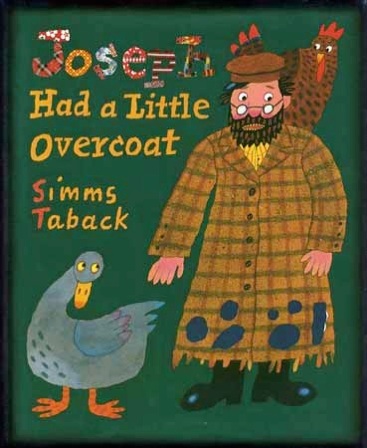
Joseph Had A Little Overcoat (Traditional)
Taback, Simms. Joseph Had a Little Overcoat. New York: Viking, 1999. ISBN 0670878553
Plot Summary
A Jewish man named Joseph wears out his overcoat, but he does not get rid of it. Instead, Joseph reuses what he can to create useful clothing items. The process repeats with Joseph never wasting what is worn, but instead creating wonderful new, albeit shrinking, items of clothing. When finally there is no cloth left to reuse, Joseph does not lose his innovative spirit- he creates something out of nothing!
Critical Analysis
Joseph shows innovation in this waste-not want not tale retold by Taback. The intricate illustrations become critical to Taback’s take on a traditional Yiddish folk song as the book’s words are so few in number. The detail that is lacking in the simple, yet comfortably repetitive story line allows for the intricate pages of art to become the main focus.
Each page details Joseph’s creation or use of his ever smaller “overcoat” in front of an always curious crowd of adults or animals. Cutouts concretely illustrate to younger readers the reuse of the same fabric in each new object. The many mediums (including pencil, ink, watercolor, gouache, and collage) allow the reader to repeatedly study the art, each time with new insight and revelation. A strong sense of Jewish culture is demonstrated in the themes of working hard and wasting little as well as through the history lesson portrayed via the many Jewish sayings, customs, objects, plays, and people represented in the illustrations. Joseph Had a Little Overcoat is a book destined to be well loved, reread, and carefully studied by children.
Awards and Review Excerpts
2000 Caldecott Honor
Publishers Weekly- “effective repetition and an abundance of visual humor”
School Library Journal- “bursting at the seams with ingenuity”
The Horn Book v.76- “clever, visually engrossing, poignant”
Connections
*Use this book to teach sequencing skills with younger children.
*After reading this book, let students cut pictures from magazines to incorporate into their own artwork.
*Another relevant art activity would be to create art out of “nothing”- trash!
*Use this book as a follow up to a unit of study on Jewish culture or after a unity of study on the 3 Rs (Reduce/Reuse/Recycle).
*Read other traditional Yiddish Folktales, including...
Schwartz, Howard. Gathering sparks. New York: Roaring Brook Press, 2010. ISBN 1596432802
Zemach, Margot. It could always be worse : a Yiddish folk tale. New York: Farrar, Straus and Giroux,
1990. ISBN0374436363
Waldman, Debby. A sack full of feathers. Victoria, BC: Orca Book Publishers, 2006. ISBN1551438631
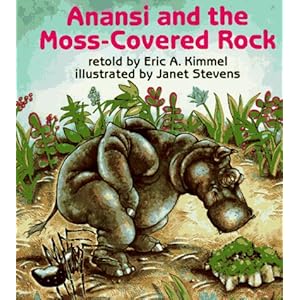
Anansi and the Moss-Covered Rock (Traditional)
Kimmel, Eric A. Anansi and the Moss-Covered Rock. Ill. by Janet Stevens. New York: Holiday House, 1988. ISBN 082340689X
Plot Summary
A smart and devious spider named Anansi discovers a magical rock with the power to render visitors unconscious. Anasni, being both intelligent and lazy, decides to use the rock’s power to steal other animal’s hard earned food. Fortunately for the other forest animals, one animal catches on and gives Anansi a taste of his own medicine!
Critical Analysis
In this trickster folktale retold by Eric Kimmel, the reader catches a glimpse of many of humanities worst traits in the leading character, Anansi. His selfish and lazy ways sharply contrast his friendly and innocent animal counterparts in the jungle. It does not take long for the reader to begin cheering for the jungle animals and hoping for Anansi’s defeat. Despite their support for the assortment of jungle animals, readers will find themselves laughing as animal after animal repeat the same mistakes.
The idyllic jungle setting presented by the bright and cheerful illustrations provide the perfect setting to this book. Readers can easily imagine the large spider relaxing in paradise while planning his deceptions. Traditional African animals and fruits hint at the story’s origins, but do not prevent the story from being universally understood. A quick introduction into the story allows for an action packed book that begs to be read with exaggerated expressions and wide sweeping gestures. Comical illustrations, paired with repetition of plot will allow even the youngest of readers to understand the absurdity of the situation. Young children will love reenacting Anansi’s discovery of the magical rock and his evil conniving, along with the dramatic collapse of each forest animal. Readers will be glad when good triumphs evil, but will not be disappointed to learn that Anansi has not yet learned his lesson!
Awards and Review Excerpts
Booklist Monthly Selections 1993
Children’s Books of the Year 1990
Nevada Young Readers Awards
School Library Journal- “colorful illustrations add detail, humor, and movement”
Connections
*After story becomes familiar, allow early childhood students to act out parts as the book is read.
*Turn this book into a reader’s theater for older elementary students.
*With middle school and high school students, allow this book to serve as an introduction to world cultures, specifically African cultures.
*Pair this book with other Anansi tales to guide students through in depth character analysis.
Aardema, Verna. Anansi does the impossible! : an Ashanti tale. New York: Aladdin Paperbacks, 2000.ISBN 0689839332
Kimmel, Eric. Anansi goes fishing. New York: Holiday House, 1992. ISBN 0823410226
Kimmel, Eric. Anansi and the magic stick. City: Holiday House Inc, 2001. ISBN 0823417638
Kimmel, Eric. Anansi and the talking melon. New York: Holiday House, 1994. ISBN 0823411672
McDermott, Gerald. Anansi the spider: a tale from the Ashanti. New York: Henry Holt and Co, 1986.
ISBN 0805003118
Sunday, September 11, 2011
City Dog, Country Frog (Mo Willems)
Willems, Mo. City Dog, Country Frog. Ill. by Jon Muth. New York: Hyperion Books for Children, 2010. ISBN 1423103009
Plot Summary
The poignant story by Willems follows a dog through a memorable year in which he discovers the joy of friendship and the sorrow of loss. Dog finds a close friend in a frog during spring. Through summer they continue to grow in friendship. As fall comes and the easiness of summer fades, frog begins to show his age and so the pair of friends remember their time together. With winter comes the sad loss of frog. The book concludes with spring’s reemergence and a reminder that life is an ongoing cycle.
Critical Analysis
Few words are printed on each page, and yet Mo Willems and illustrator Jon J. Muth have accomplished creating an epic story of friendship. The free spirited dog from the city and kind frog from the country make an odd but endearing couple. The characters speak for themselves during portions of the book, providing insight into their friendship, while the narrator quietly gives a detached account of the friendship. This understated style of writing allows readers of all ages to put their life knowledge and experiences into the story and take out of it what they will.
Vibrant, colorful water colors give life to and carefully expresses both of the main characters’ personalities. The vivid illustrations also provide the perfect back drop to the plot’s changing seasons in the countryside.
Readers of all ages, young and old, will find themselves making connections with the "city" dog and "country" frog, and implicitly understanding their friendship. Loss and renewal is a universal theme, lovingly depicted in this carefully crafted story.
Awards and Review Excerpts
School Library Journal- “Spare, poignant, and ultimately upbeat”
Booklist starred review- “Adults and children will each take away something”
Connections
*This book is great lead in to discussions on seasons and loss/grief.
*After reading this book, make a collage to represent each of the four seasons. Suggested readings to accompany a discussion of the seasons include the Celebrate the Season book collection by Linda Glaser.
Glaser, Linda. It's Fall. Brookfield, Conn: Millbrook Press, 2001. ISBN 0761313427
Glaser, Linda. It's Spring. Brookfield, Conn: Millbrook Press, 2002. ISBN 0761313451
Glaser, Linda. It's Summer. Brookfield Conn: Millbrook Press, 2003. ISBN 076131735X
Glaser, Linda. It's Winter. Brookfield, Conn: Millbrook Press, 2002. ISBN 0761316809
*Listed below are other books that can be combined with City Dog, Country Frog to address and open discussions of different types of loss experienced by children.
Carlstrom, Nancy. I'm Not Moving, Mama. New York: Aladdin Paperbacks, 1999. ISBN 0689828810
Demas, Corinne. Saying Goodbye to Lulu. Boston New York: Little, Brown, 2004. ISBN 031604749X
Varley, Susan. Badger's Parting Gifts. New York: Lothrop, Lee & Shepard Books, 1984. ISBN 0688115187
Viorst, Judith. Alexander, Who's Not (Do You Hear Me? I Mean It!) Going to Move. New York, NY: Aladdin Paperbacks, 1998. ISBN 0689820895
Viorst, Judith. The Tenth Good Thing About Barney. New York: Aladdin Books, 1988. ISBN 0689712030
Subscribe to:
Posts (Atom)