Sunday, November 13, 2011
The Wednesday Wars (Historical Fiction)
Schmidt, Gary. The Wednesday Wars. New York: Houghton Mifflin Harcourt, 2009.
Summary
The Wednesday Wars is the story of a seventh grade boy with the distinguishing factor of being the only Presbyterian in class. This may seem to be a minor setback in his predominately Catholic and Jewish community, but being Presbyterian means a whole lot more. He is the only student left out of religious training on Wednesday afternoons and the only student stuck in Mrs. Baker’s classroom. Holling is sure Mrs. Baker is determined to ruin his life as he cleans rat cages and reads Shakespeare. Readers will be engrossed by this humorous story of a boy who happens upon a journey of self discovery amongst the turmoil of the Vietnam War and the civil rights movement.
Critical Analysis
Holling Hoodhood is a relatable and likable lead character. He wins his audience over immediately with his honest, hilarious, and age appropriate descriptions of his town, life, and teacher. His loyal friends and inattentive parents could be from any era, yet fit seamlessly into the 1970s. Holling’s teacher, Mrs. Barker, who serves as both his sworn enemy and eventual ally is sometimes too ideal. Despite this fact, readers will come to admire and enjoy her very human qualities, such as her worry for her own husband fighting in Vietnam and her constant eye rolling and exasperation at the students.
Accurate descriptions of Walter Cronkite’s reports on Vietnam dominating the family’s television, cream puffs being sold for under a quarter, the assassinations of Bobby Kennedy and Martin Luther King, and “modern” architectural designs mesh together to create the background for Holling’s journey. The time period is paramount to many of the story lines, such as his sister’s efforts to become a “flower child”, but is not the focus of the book. Instead, Gary Schmidt accurately depicts this tumultuous time period from the perspective of a boy who remembers little else. Even young adult readers who know next to nothing of the 1970s will be captivated by Schmidt’s depiction of a boy striving to keep friends, please his parents, and have fun. The classic themes of first love despite enemy families, inner-family conflict, and coming of age make this book a success.
Awards and Review Excerpts
ALA Notable Book
Newbery Honor Book
Booklist Starred Review- “gentle, hopeful, moving story of a boy”
Publisher’s Weekly- “serious issues are leavened with ample humor, and the supporting cast...is fully dimensional,”
School Library Journal- “laugh-out-loud moments that leaven the many poignant ones”
The New York Times- “The Wednesday Wars was one of my favorite books of the year”
Connections
Encourage readers to find out more about supporting characters in The Wednesday Wars.
Schmidt, Gary. Okay for now. New York: Clarion Books, 2011.
Suggest these titles to readers who enjoyed Schmidt’s style of writing.
Schmidt, Gary. Lizzie Bright and the Buckminster boy. New York: Laurel-Leaf Books, 2008.
Schmidt, Gary. Trouble. Boston: Graphia, 2010.
Learn how the war in Vietnam changed lives through these memoirs and informational texts.
Caputo, Philip. 10,000 days of thunder : a history of the Vietnam War. New York: Atheneum
Books for Young Readers, 2005.
Murray, Stuart. Vietnam War. New York: DK Pub, 2005.
Warren, Andrea. Escape from Saigon : how a Vietnam War orphan became an American boy. New
York: Farrar, Straus and Giroux, 2008.
Help students understand the Vietnam War these fictional texts:
A picture book to open discussion on the lasting impact of war, particularly the Vietnam War.
Bunting, Eve. The wall. New York: Clarion Books, 1990.
A novel following the experience of a trained combat dog and young solider in the Vietnam War.
Kadohata, Cynthia. Cracker!: the best dog in Vietnam. New York: Atheneum Books for Young
Readers, 2007.
A novel in verse describing an American soldier's experiences in the Vietnam War.
Myers, Walter. Patrol: an American soldier in Vietnam. New York: Harper Trophy, 2005.
Thursday, November 3, 2011
Let Me Play (Informational Books)
Blumenthal, Karen. Let me play : the story of Title IX : the law that changed the future of girls in America. New York: Atheneum Books for Young Readers, 2005.
Summary
Today, no one batts an eye when a young girl says her dream is to win a gold medal in the Olympics or go to college on a softball scholarship. This was not always the case. It took years of hard work by strong women to lay forth a law in the 1970s that would change how America viewed equality, gender, and athletics. Nonfiction author Karen Blumenthal takes readers on a fascinating exploration of how Title IX came about and impacted the lives of girls and young women in the United States in her book, Let Me Play: The story for Title IX: the law that changed the future of girls in America.
Critical Review
Blumenthal surveys the incredible endeavor of many individuals in their work to achieve gender equality in school sport’s programs across America in Let Me Play. In the book, she skillfully combines primary and secondary resources to create a seamless story of the groundbreaking legislation Title IX. Events are chronologically laid out and divided into chapters that correspond to major happenings in the creation and implementation of Title IX. The source notes and index are logically organized and provide readers with easy access to information from within the book.
Let Me Play is visually appealing and engaging to read with its straightforward language, combined with photographs, graphs, quotes, and cartoons. Short stories, such as the “player profiles” cover women athletes and “instant replays” tell real life anecdotes and serve to strategically break up large chunks of text and make history appear to come alive. The text demonstrates a flair for factual storytelling that challenges readers of all ages to understand history as it really was and it defines the future.
Awards and Review Excerpts
2003 Robert F. Silbert Informational Honor Book
ALA Notable Children’s Book
Publishers Weekly Best Children’s Book of 2002
Booklist- “Few books cover the last few decades of American women's history with such clarity and detail”
School Library Journal- “A fascinating look at the birth, growth, stagnation, and final emergence of Title IX.”
The Horn Book- “richly layered presentation”
Connections
Read stories of inspiring women in sports:
Krull, Kathleen. Wilma unlimited : how Wilma Rudolph became the world's fastest woman. San Diego: Harcourt, Inc, 2000.
Macy, Sue and Jane Gottesman. Play like a girl : a celebration of women in sports. New York: Henry Holt, 1999.
Learn more about the history of womens sports:
Macy, Sue. Basketball belles : how two teams and one scrappy player put women's hoops on the map. New York: Holiday House, 2011.
Stout, Glenn. Yes she can! : women's sports pioneers. Boston: Sandpiper, 2011.
Give students an opportunity to read one of these novels as they look for connections:
Curtis, Christopher. The Watsons go to Birmingham--1963:a novel. New York: Dell Laurel Leaf, 2000.
Murdock, Catherine. The off season. Boston: Houghton Mifflin, 2007.
Park, Linda. Keeping score. Boston: Sandpiper, 2010.
Our Eleanor (Informational Books)
Fleming, Candace. Our Eleanor : a scrapbook look at Eleanor Roosevelt's remarkable life. New York: Atheneum Books for Young Readers, 2005.
Plot Summary
Eleanor Roosevelt was more than a first lady. She was was a revolutionary thinker that managed to permanently impact America’s view of social justice. Our Eleanor begins with a look at Eleanor’s family tree and difficult upbringing and progresses to her complicated roles as mother, wife, and friend. Other portions of the biography work to contrast this very human view of Eleanor by reflecting on her remarkable ability to connect with the poor and disadvantaged members of society and her confidence in fighting for their rights. Flemings utilizes quotes, diary entries, articles, images, and short anecdotes to gain glimpses into Eleanor’s mind and heart.
Critical Analysis
Our Eleanor: a scrapbook look at Eleanor Roosevelt’s remarkable life is a comprehensive look at Eleanor Roosevelt’s influential existence. The biography covers events from Eleanor’s birth to her death in areas of both private matters and social endeavors. Fleming delves into where Eleanor came from, how she evolved, and how she continues to impact society.
The book takes an honest and intimate approach by viewing Eleanor as a strong and yet flawed character. Quotes from Eleanor give intimate glimpses into her personal life, such as when Eleanor explains, “It did not come naturally to me to understand little children or enjoy them” (32). Fleming guides the reader through a scrapbook style look at Eleanor’s life that incorporates narrative, lists, photographs, and documents that serve to create active engagement with the text. Graphics support and add interest to text, such as black and white print of a National Youth Administration poster that demonstrated one of Eleanor’s programs (93) or photos of Eleanor baking in her cottage after leaving the white house (130).
The book fails to follow the traditional chronological path of most biographies but instead focuses on snapshots and topics within Eleanor’s life. As Fleming best states, the book will guide readers and “like a jigsaw puzzle, the many pieces of her life will slowly fit together to form the picture of an extraordinary woman” (ix). Readers will be forced to critically analyze Eleanor as they realize that even heros and heroines are flawed but still worthy of emulation. This biography has a unique style allows it to be viewed in bits and pieces while engrossing its readers and encouraging further reading.
Awards and Review Excerpts
ALA Best Books For Young Adults 1997
Notable Children’s Books 1997
Publishers Weekly Starred Reviews
Booklist- “a broad audience, including many adults, will be intrigued by the volume's photo-album immediacy”
Kirkus Reviews- “an incredibly well-organized and thorough scrapbook”
Publishers Weekly- “Fleming allows readers to draw their own conclusions; they will come away with an understanding of a woman who shaped her times and left a lasting imprint on the future.”
School Library Journal- “Enjoyably educational”
Connections
Young Adults can discover other influential and/or inspirational women by reading these biographies.
Cooper, Ilene. Oprah Winfrey : a twentieth-century life. New York: Puffin Books, 2008.
Fleming, Candace. Amelia lost : the life and disappearance of Amelia Earhart. New York: Schwartz & Wade Books, 2011.
Fradin, Judith. The power of one : Daisy Bates and the Little Rock Nine. New York: Clarion Books, 2004.
Hamilton, Bethany. Soul surfer : a true story of faith, family, and fighting to get back on the board. New York: Pocket Books MTV Books, 2006.
Jackson, Livia. I have lived a thousand years : growing up in the Holocaust. New York, N.Y: Aladdin Paperbacks, 1999.
Nichols, Joan. Mary Shelley, Frankenstein's creator : first science fiction writer. Berkeley, CA Emeryville, Calif: Conari Press Group West distributor, 1998.
Follow up Our Eleanor with these reads on Eleanor Roosevelt aimed at younger audiences.
Adler, David. A picture book of Eleanor Roosevelt. New York: Holiday House, 1991.
Cooney, Barbara. Eleanor. New York: Scholastic, Inc, 1999.
Times for Kids. Eleanor Roosevelt : first lady of the world. New York: Harper Collins Publishers, 2006.
They Called Themselves the K.K.K. (Informational Books)
Bartoletti, Susan. They called themselves the K.K.K. : the birth of an American terrorist group. Boston: Houghton Mifflin Harcourt, 2010.
Summary
Bartoletti weaves the tale of the war strewn south after the American Civil War and the beginnings of the well known terrorist group, the Ku Klux Klan, during the period of reconstruction. Sequential chapters allow young adults to grasp how society’s mindset and widespread prejudices allowed for a small group of men to grow into a widespread, highly secretive society of hate. The in-depth look into the group concludes with President Grant’s eventual crackdown on the Ku Klux Klan and its gradual retreat from mainstream society, but reminds the reader that hate groups still exist in United States to this day.
Critical Review
They Called Themselves the K.K.K.: the birth of an American terrorist group is detailed and well researched presentation of the Ku Klux Klan. Young adult readers may find the grim subject matter is difficult to read with its intimidatingly crisp layout and honest portrayal of the treatment of African Americans in American society. The use of black and white pictures, documents, uncensored quotes, historical artist renderings, and satirical cartoons serve to break up dense passages of information and provide further insight into the life of freed slaves and the individuals who were part of the K.K.K..
Bartoletti retells events concisely while providing readers with enough first hand anecdotes from freed men and women and Klan members to encourage critical thinking. For example, a quote from Susan Merrit, a freed woman, gives readers insight into a life where even her religion was encroached upon by former slave owners and members of the Ku Klux Klan. A time line at the end of the book provides readers with perspective and quote attributions and source notes serves the needs of individuals looking to do further research.
Readers will find this book to be a somber, yet much needed glimpse into how unchecked prejudices led to shameful acts and the formation of a terrorist group.
Awards and Excerpts
ALA Notable Books
Booklist Editors Choice 2010
Horn Book Magazine Starred Review Titles
Kirkus Starred Review
Booklist- “amirably clear, accessible language”
Kirkus- “An exemplar of history writing”
School Library Journal- “compelling clarity, anecdotal detail, and insight”
Connections:
Use these book as read alouds on slavery and segregation:
Hopkinson, Deborah. Sweet Clara and the freedom quilt. New York: A. Knopf, 1995.
Levine, Ellen. Henry's freedom box. New York: Scholastic Press, 2007.
Wiles, Deborah. Freedom Summer. New York: Aladdin Paperbacks, 2005.
Woodson, Jacqueline. The other side. New York: Putnam's, 2001.
Learn about terrorist groups and actions that arise from hatred and/or fear:
Bartoletti, Susan. Hitler Youth : growing up in Hitler's shadow. New York: Scholastic Nonfiction, 2005.
Isaac, John. Rwanda : fierce clashes in Central Africa. Woodbridge, Conn: Blackbirch Press, 1997.
Lange, Dorothea. Impounded : Dorothea Lange and the censored images of Japanese American internment. New York London: W.W. Norton, 2008.
Meltzer, Milton. The day the sky fell : a history of terrorism. New York: Random House, 2002.
Michelson, Maureen. Looking like the enemy : my story of imprisonment in Japanese-American internment camps. Troutdale, OR: NewSage Press, 2010.
Use one of these books as a conclusion to discussions on hate groups, hate crimes, and bullying.
Fox, Mem. Whoever you are. Orlando: Voyager Books Harcourt, 2001.
Seskin, Steve. Don't laugh at me. Berkeley: Tricycle Press, 2002.
Plan a cultural fair to celebrate unity within your school or classroom.
Thursday, October 13, 2011
Mirror, Mirror (Poetry)
Singer, Marilyn. Mirror, Mirror. Ill. by Josee Masse. New York: Dutton Children’s Books, 2010.
Plot Summary
The book brings to light the difference one’s point of view can make. Mirror, Mirror is an amazing poetry puzzle that can be read from beginning to end and end to beginning resulting in new takes on the same story. This new type of poetry, the reversible verse or reverso, makes for interesting and playful character studies of classic fairy tale heros, and the occasional villain.
Critical Analysis
This book of reversos will have both adults and children captivated by its unique charm and creativity. Popular fairy tale characters come to life in new ways as Singer allows them to express their perspective.
The layout of the book has been chosen to emphasize the alteration of the poems, as each reverso is paired side by side with its counterpart. In the same way, Masse has provided vivid illustrations for each side of the poem. They are juxtaposed perfectly next to each other. Bright crisp images divide pages in half and yet they comfortably entwine, showing the connection of stories.
The poem “Have Another Chocolate”, based on the story of Hansel and Gretel, is a great example of the books entirety. It demonstrates the dichotomy between the main characters by merely placing carefully worded lines in reverse and changing some punctuation. This combined with the discerning use of simile and carefully chosen words create delightful twists. Suddenly images change with words and “When you hold it out/your finger/feels like a bone” becomes the sage advice of another captive in “a bone/feels like/your finger/when you hold it out.”
“In the Hood” is another poem that will appeal to readers with its strong rhythm, refreshing rhymes, and delightful diction. Readers will appreciate the dual use of the word hood. As used by the innocent Red Riding Hood it is traveling cape but when the Big Bad Wolf relates his thoughts it is his territory through which Red Riding Hood is trespassing.
Mirror, Mirror is a new and exciting look at children’s poetry that is sure to impact authors and aspiring poets of the future.
Awards and Review Excerpts
Booklist- “will have readers marveling over a visual and verbal feast”
Kirkus- “celebration of language, imagery, and perspective”
School Library Journal- “a marvel to read” with “vibrant artwork”
Connections
*Discuss point of view after reading this book of verse in reverse. Use other books to continue discussion of point of view.
Bret, Jan. Town Mouse, Country Mouse. New York: Puffin, 2003. ISBN 069811986X
Housey, Amber. Just Because: Where Another Point of View Makes a Better You! Ill by Denise Clemmensen. Ferne Press, 2011. ISBN 1933916907
Scieszka, Jon. The True Story of the 3 Little Pigs! Ill by Lane Smith. New York: Puffin Books, 1996. ISBN 0140544518
Stevens, Janet and Susan Stevens Crummel. Help Me, Mr. Mutt!: Expert Answers for Dogs with People Problems. Ill. Janet Stevens. Orlando: Harcourt Children’s Books, 2008. ISBN 0152046283
*Invite students to perform a duo of poems from Mirror, Mirror. Students will love reenacting poems, especially when given prompts and taught to manipulate their voices.
*Use Mirror, Mirror as an opening in Math to discuss the importance of position and placement. This would be particularly well suited to lessons in writing word forms of numbers and ordering numbers.
*Pair this book with a favorite fairy tale to add more complexity to students understanding of the characters.
Button Up! Wrinkled Rhymes (Poetry)
Schertle, Alice. Button Up!: Wrinkled Rhymes Ill. by Petra Mathers. New York: Harcourt Children’s Books, 2009.
Plot Summary
Button Up! Wrinkled Rhymes is a collection of poetry written from the perspective of items of clothing. Well loved childhood favorites, such as the soccer jersey and galoshes each get their own poem, as well as some still familiar, but less enjoyed items like the wool sweater. Colorful and often humorous watercolors illustrate each poem, showing animals (and human) donning their clothing with pride. The poems are upbeat and display strong rhythm, making them perfect for reading aloud to young children.
Critical Analysis
The book provides upbeat, fast paced poetry well suited to the theme of this collection. The personification of clothing items provides a unique and fresh prospective for writing poetry aimed at younger audiences. Pre-kinder and kindergarten students will find the topics relevant and a comfortable place to begin learning poetry.
The poems demonstrate clear, but occasionally forced rhymes. For example, in "Hand-me-down Sweatshirt" the rhyme becomes confusing and feels unnatural when the sweatshirt explains it “was passed down to may/ she passed me to Karly/ I’m Andrew’s today.”
Despite some weaknesses, the collection is interesting and fun. In "Clyde’s Costume", Schertle uses a combination of alliteration, rhythm, and easy rhyme that will engage young listeners. Other poems, such as "Jennifer’s Shoes" provides strong tactile and visual information that captivate the senses. Readers will involuntarily wiggle their toes when they hear “toes are curled/the softness of carpet/ the steepness of stair/the curve of the chair”. The "Song of Harvey’s Galoshes" will be another favorite when read aloud with its repetition and sing-song use of onomatopoeia, “Squash-galosh, squash-galosh, through the slime” that will have children eagerly chiming in.
Some of the poems will create an immediate emotional connection with the reader, perfectly expressing a point of view and sentiment. Listeners will connect with "Rick’s Wool Sweater" when he admits guilty pleasure, “Still.../To tell the truth it tickles me/To be a little prickly.” The poems are meant to entertain and do so wonderfully.
The illustrator has created bright, cheerful, and quirky images of joyful animals with her watercolors. There is a great sense of textural quality to the paintings that will allow readers to study the pictures carefully. Certain images, such as the illustration for The "Song of Harvey’s Galoshes" provide a strong sense of movement which serves to provide a carefree joy to the work.
Awards and Review Excerpts
Booklist- “begs to be read aloud”
Children’s Literature- “whimsical watercolor illustrations are engaging”
School Library Journal- “small, snappy verses”
Connections
*Have students create poems from the perspectives of familiar objects (such as the crayon) in the classroom and create a class book.
*Teach rhyme to younger students using poems with strong rhymes, such as “Bill’s Blue Jacket” and “Hand-me-down Sweatshirt”.
*Use the familiar clothing items in the poems to work on visualization. Read a poem aloud to students without sharing the illustrator’s image. Have students create and share their own illustrations.
*Follow up Button Up! with The Man Who Wore All His Clothes as a read aloud chapter book with non readers or as an independent text for readers.
Ahlberg, Allan. The Man Who Wore All His Clothes. Ill. Katherine McEwen. London: Walker Childrens Paperbacks, 2002. ISBN 0744589959
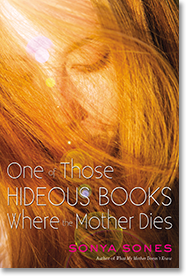
One of Those Hideous Books Where the Mother Dies (Poetry)
Sones, Sonya. One of those hideous books where the mother dies. New York: Simon & Schuster Books for Young Readers, 2004. ISBN 0689858205
Plot Summary
This fast paced novel in verse is told through the perspective of a young teenager named Ruby. Early in the book readers discover that Ruby is no ordinary teenager, but the daughter of a recently deceased mother and an estranged father, who just happens to be a famous actor. The plot reveals the everyday turmoil and confusion of being a teenager, with common teenage themes of relocation, friendship, and first love. More unexpected, the novel follows Ruby’s emergence through the grief of losing a mother and stress of developing a relationship with her previously unknown father.
Critical Analysis
One of Those Hideous Books Where the Mother Dies is full of predictable plot and over the top scenarios, locations, and drama. Despite this, its quick pace and laugh out loud humor gives it an addictive quality similar to eating chocolate or watching a soap opera on daytime television. Teens will have fun imagining going from middle class teenager to offspring of the rich and famous. Furthermore, this book goes beyond a fun read and becomes memorable and recommendable because of the deep and honest quality of it’s star character, Ruby. The book details the personal thoughts of its main character in a language that will feel relaxed and familiar to the average American teenager. Finally the reader can openly relate to the book and make connections beyond wishful or sympathetic thinking.
The free verse of the book provides an ideal avenue to express Ruby’s many emotional states. Sones’ arrangement of stanzas and lines within each poem serve to emphasize or articulate the expression of certain emotions. For example, when Ruby uses three lines to state “Now I hate the rain” the reader fully digests how even the small things in Ruby’s life have changed since her mother’s death (208). Direct, meaningful, and occasionally laconic language will find home with reluctant and avid readers alike.
Review Excerpts
Publisher’s Weekly- “winning portrayal of a teenage girl's loves and losses”
Booklist- “acrimonious, raw, and very funny”
Kirkus Reviews- “the fulfillment of many a teen's fantasies”
Connections
*Other suggested books in verse by Sonya Sones
Sones, Sonya. What my mother doesn’t know. New York: Simon & Schuster Books for Young Readers, 2001. ISBN 0689841140
Sones, Sonya. What my girlfriend doesn’t know. New York: Simone & Schuster Books for Young Readers, 2008. ISBN 0689876033
Sones, Sonya. Stop pretending, what happened when my big sister went crazy. New York: Harper Teen, 1999. ISBN 0064462188
*University of Texas suggests these texts with related themes (http://www.edb.utexas.edu/resources/booksR4teens/book_reviews/book_reviews.php?book_id=124).
Cisneros, Sandra. House on Mango Street. New York: Vintage Press, 1991. ISBN 0679734775
Janeczko, Paul B. Preposterous: Poems of Youth. New York. Orchard Books, 1991. ISBN 0531059014
Mackler, Carolyn. Love and Other Four-Letter Words. New York: Delcorte, 2000. ISBN 044022831X
Subscribe to:
Posts (Atom)